Tops for sewer applications have for many years been made of cast iron, a durable and solid product. In certain circumstances, composite tops may be an alternative. A European standard – NBN EN 124-5 – already exists and COPRO is currently working on the certification of this product. To avoid unnecessarily hindering innovative developments such as the use of composite tops for roads, the innovation certificate was introduced.
With this certificate, an innovative product can be deployed more quickly after consultation within a group of experts. - Kris Vandenneucker, Certification Manager at COPRO.
The certification of composite tops under the COPRO mark is carried out in accordance with the European standard NBN EN 124-5, which applies to gully tops and manhole tops for vehicular and pedestrian areas. Part 5 concerns grates and tops for manholes and gullies made of composite materials. Based on this standard, COPRO began preparations for certification of tops in composite materials. Partly at the request of producers and suppliers, a Sectoral Committee was set up to establish the certification rules. The meetings of this Sectoral Committee resulted in Application Regulation TRA 33 – applicable since November 2018 – for product certification of gully tops and manhole tops for vehicular and pedestrian areas made of composite materials.
KEY BENEFITS
“Composite tops have important advantages”, says Kris Vandenneucker. “They are significantly lighter than cast iron products and therefore more ergonomic, they are radiation-permeable, which is very interesting for telecom applications, and they are more corrosion-resistant. The latter is an important advantage given the separate sewerage systems that have been increasingly constructed in recent years. This means that the wastewater sewage is no longer flushed during a heavy rain shower, giving rise to aggressive environments (sulphur-containing gases, ed.) which can seriously corrode cast iron tops.”


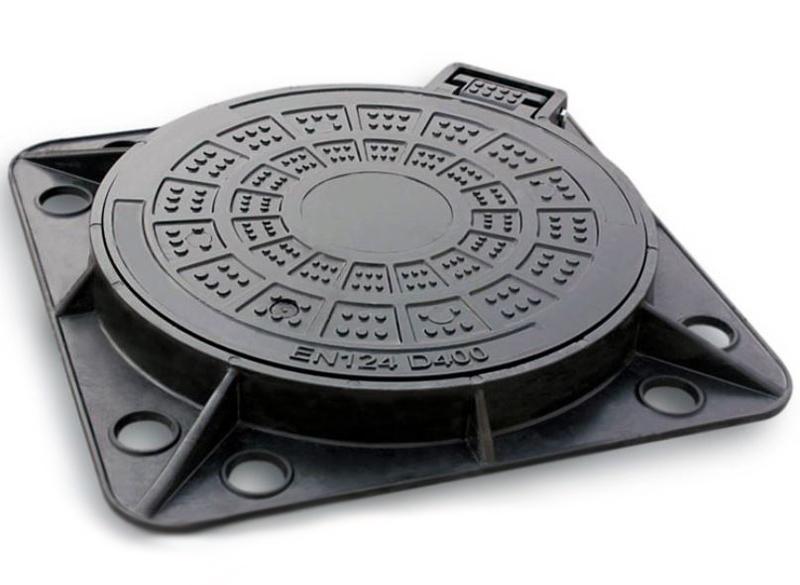
Since it is also permitted to use the composite tops in road applications (class D400 according to the NBN EN 124-1 standard), governments are requesting that additional technical specifications be established in addition to NBN EN 124-5. COPRO is busy working on documenting these technical specifications, which were also discussed during the Sectoral Committee meetings, in a PTV so that high-quality, certified composite tops for roads can be offered on the market in the future. Kris Vandenneucker: “But this could take several years. In order not to hinder innovation, an innovation certificate can therefore be awarded at project level.”
INNOVATION CERTIFICATE
COPRO – together with the sector – introduced the innovation certificate as a valuable intermediate step. After consultation within a panel of experts, this certificate can be awarded, allowing the product to be deployed more quickly under specific circumstances. Kris Vandenneucker: “And in the meantime, work continues on drawing up the PTV. The experiences gained on-site through an innovation certificate and the results that are obtained are, of course, also very interesting input for the PTV. For example, if we see that the top is still functioning well after approximately 1 million wheel transitions, we can include that in the PTV.”
There is already a European standard for composite tops containing durability requirements and an accelerated ageing test. But governments are asking for additional technical specifications, especially a stricter ageing test. “The current standard currently requires around 500,000 wheel transitions for Class D400. But on a busy road you’ll quickly reach that point, which means the test is not actually representative of the lifespan of the tops. This is an important aspect that we discuss within the advisory board. We of course urge governments and clients to already utilise the innovation certificate for the application of composite tops, carefully considering the potential risks. In this way, innovation is encouraged and the preparation of the PTV is stimulated.
This article also appeared in the GWW-Bouw magazine and can be found here in digital format.