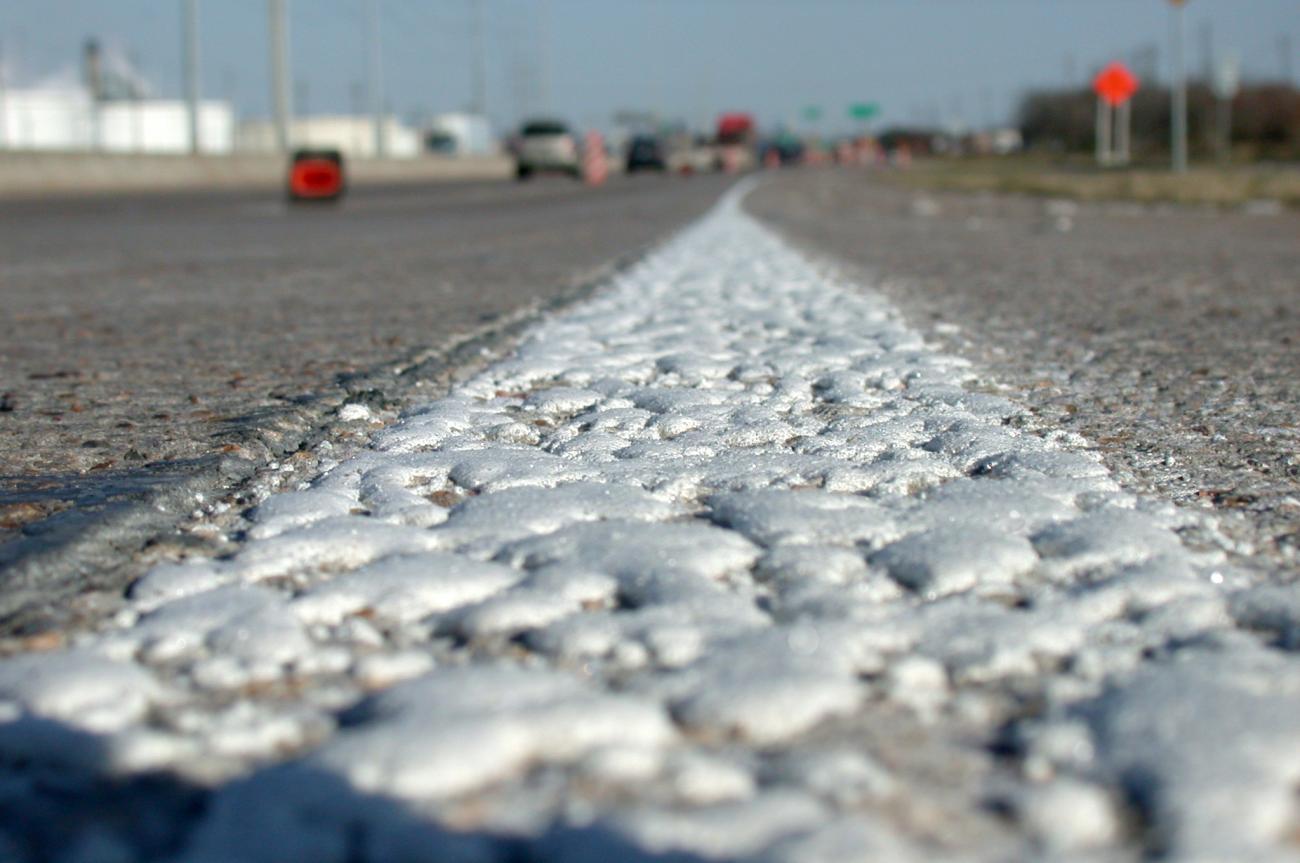
Road markings play a crucial role in road safety. Fulcrane De Bruyn, Certification Manager at COPRO, emphasises that guaranteeing the quality of these markings is essential. “The road marking systems used on our public roads therefore undergo an extensive certification process, coordinated by COPRO and the authorities of the Flemish Agency for Roads and Traffic (AWV) and Public Service Wallonia (SPW)”.
Every road user will agree that clearly visible road markings contribute to road safety. COPRO plays an important role in both the CE marking and the BENOR certification of road marking products. Thanks to strong collaboration between COPRO, the producers of road marking products, and the various regions of our country, certification makes a significant contribution to product quality and road safety.


BAILLONVILLE TRIAL SECTIONS
The road marking products used in Belgium are subject to conformity checks. These testing procedures include official tests on day and night visibility, skid resistance and visibility in rain and wet weather. This provides a measure of the general durability of these marking systems.
For this purpose, test sections (according to the specifications of the NBN EN 1824 standard and the G0025 guideline) are foreseen on the N63 (between Marche-en-Famenne and Liège) in Baillonville. Every year, a homologation campaign for these systems takes place, in cooperation with the AWV and SPW.
Fulcrane De Bruyn: “Tests were again carried out in Baillonville in May of this year. A total of six producers had several of their products applied. International producers are also welcome to participate in the Baillonville project. The unique aspect of these tests is that both the base material and the surface dressing material are certified separately, but tested together to determine the durability of the entire system. The checks are carried out under strictly controlled conditions to ensure fair comparisons between producers, regardless of the weather conditions during application on the test sections.”
IMPLEMENTATION CONTROL
During an inspection, it can be checked whether the combination of the base material with the surface dressing material applied at Baillonville is respected during installation. Increased implementation control can be requested on a project basis. The correct dosages and installation conditions are closely monitored on site. Fulcrane De Bruyn: “Today we already carry out inspections at project level at the request of Brussels Mobility.”


1 MILLION TYRE-ROAD INTERACTIONS
The official measurements on the test sections in Baillonville are taken after one million tyre-road interactions. “That is usually after about a year,” says Fulcrane De Bruyn. “So the next official measurements will most likely take place in May 2026. And from then on, certification can actually be requested for the basic product and the surface dressing material, provided that they also comply with the technical prescriptions (PTVs). For temporary markings, for example applied during road works, removability is also tested. It is of course important that no residue remains of these temporary markings after removal.”
PLANNING AND COMMUNICATION
The process surrounding the test sections is logistically intensive. Producers are kept informed of progress by COPRO and receive detailed reports on the measured performance of their systems. Close cooperation between all parties involved and the continuous improvement of test methods remain essential to ensure quality and safety on our roads. “Producers need to be kept informed so they can also organise themselves. Moreover, the whole process is weather dependent. The road must be completely dry before we can apply the test lines. Clear planning and good communication between all parties involved are absolutely necessary to ensure everything runs smoothly,” concludes Fulcrane De Bruyn.
This article appeared in the magazine GWW-Bouwmat 2025-04.